Beginner Guide

How to Read Astrocartography Map Lines, Symbols, and Meanings

Astrocartography can look confusing at first because the map is filled with colored lines, planet symbols, and angle labels. The simple way to read it is to focus on one place, identify the closest lines, then combine the planet meaning with the angle meaning. If you want to follow this guide on how to read astrocartography map techniques with your own data, start by using our tool to generate your astrocartography chart and then compare the map with the steps below. This page explains how to read astrocartography map results in a beginner-friendly way, without treating any single line as a fixed promise or warning. This how to read astrocartography map guide is designed to help you master how to read astrocartography map concepts step by step.

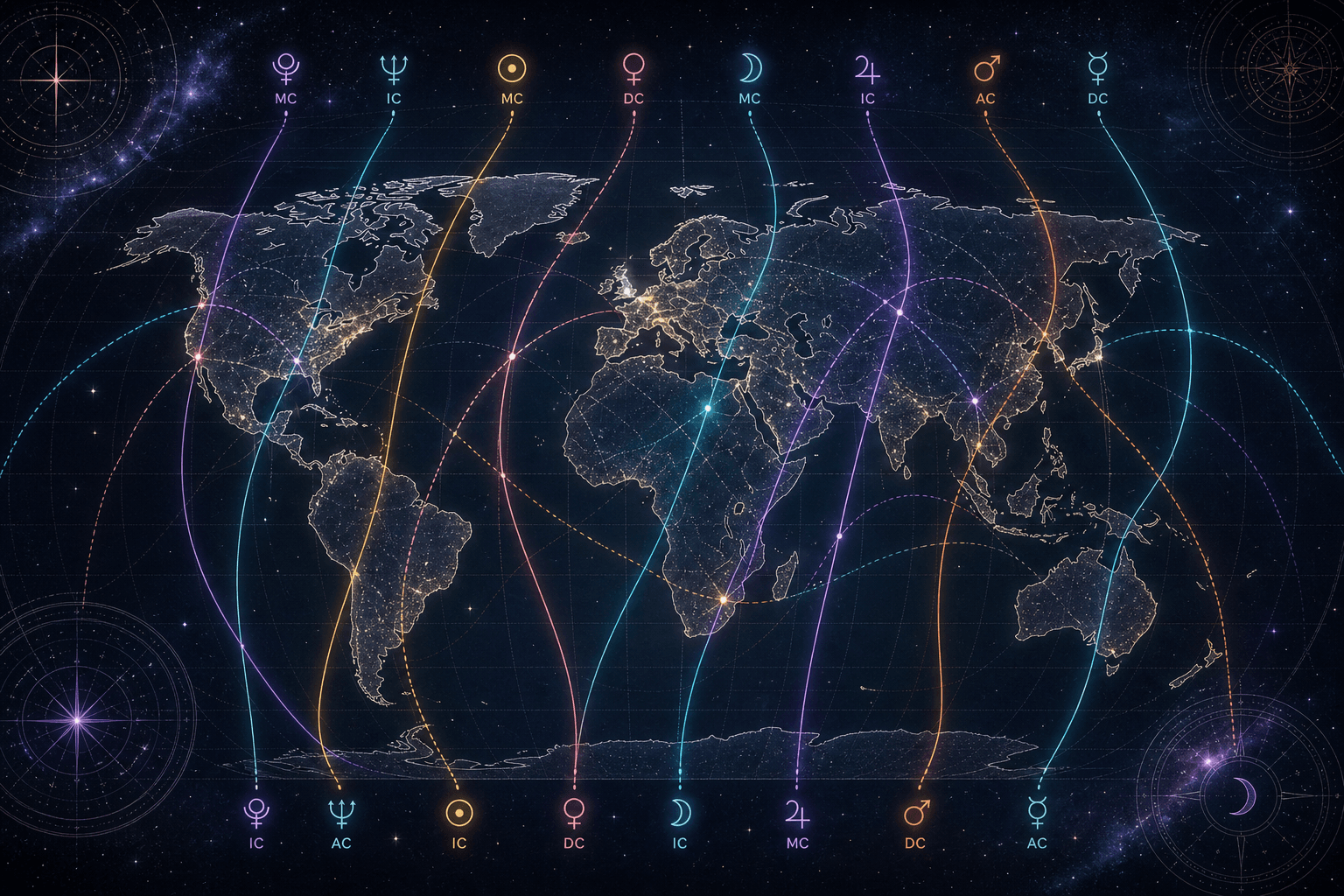
Dark world astrocartography map with colored planetary lines and AC, DC, MC, IC angle labels
A complete astrocartography map overview with planetary line paths, planet symbols, and AC, DC, MC, and IC angle labels.

What an Astrocartography Map Shows

An astrocartography map projects your birth chart onto a world map. It shows where each planet was connected to an important chart angle at the moment of your birth. These lines can suggest places where certain themes may feel stronger, such as identity, relationships, career, home, communication, love, discipline, or transformation. To understand the foundational concepts behind this mapping, see our introduction to what astrocartography is. Understanding how to read astrocartography map projections is the first step toward using this tool effectively.

The key idea is not that a city creates a totally new personality for you. Instead, a location can highlight parts of your natal chart that were already there. Learning how to read astrocartography map lines helps you compare locations with more structure, especially when you are thinking about travel, relocation, career direction, or where you feel most at home. This how to read astrocartography map tutorial will walk you through everything you need to know about how to read astrocartography map fundamentals.

What You Need Before Reading Your Astrocartography Map

Before you interpret the map, you need reliable birth information. The map depends on your birth date, birth time, and birth place. A small change in time can shift the angles, especially AC and DC lines, so the reading is only as useful as the data behind it. This how to read astrocartography map guide emphasizes accurate birth data because how to read astrocartography map accuracy depends entirely on what you put in.

Why Birth Date, Birth Time, and Birth Place Matter

Your birth date sets the basic planetary positions. Your birth place sets the original geographic reference. Your birth time determines the angles: AC, DC, MC, and IC. Because astrocartography is built around planets on angles, time accuracy matters more than many beginners expect. This how to read astrocartography map guide cannot stress enough how much birth time accuracy affects the results.

How Accurate Your Birth Time Needs to Be

A birth time within a few minutes is ideal. If your birth time is approximate, you can still explore the map, but treat exact line positions carefully. If your time is unknown, how to read astrocartography map results becomes more conceptual: you may notice broad themes, but you should avoid making major relocation decisions from uncertain lines alone. When learning how to read astrocartography map techniques, always prioritize precision in your birth data for the most reliable how to read astrocartography map experience.

How to Generate an Astrocartography Map Before Reading It

You need a map before you can read the lines. A good generator should ask for birth date, birth time, and birth place, then display planetary lines across the world. After that, zoom into the city, country, or region you actually care about instead of trying to interpret the whole globe at once. Before you learn how to read astrocartography map charts, you need to generate one—this how to read astrocartography map guide starts with that first step.

Using AstroClick Travel or an Astrocartography Map Generator

Some older guides mention AstroClick Travel as a familiar industry reference, but you do not need to make another platform your main workflow. For this site, the practical path is to create the map here, save the result, and use the same reading method for every location. Use our homepage to create an astrocartography chart before comparing specific cities. Once you have your map, you can start applying how to read astrocartography map principles to any location you want to explore.

How to Find Planet Symbols, Line Labels, and Map Details

Look for the planet symbol first, such as Sun, Moon, Mercury, Venus, Mars, Jupiter, Saturn, Uranus, Neptune, Pluto, Chiron, or the Nodes. Then read the angle label beside the line: AC, DC, MC, or IC. This label tells you which life area the planet is likely to emphasize. When learning how to read astrocartography map symbols, start with the planet and then consider the angle.

How to Read Astrocartography Map Lines Step by Step

The best way to learn how to read astrocartography map lines is to use a repeatable process. When you know how to read astrocartography map details one location at a time, the whole chart becomes easier. Do not begin by reading every line. Start with one location, identify the nearest lines, decode the angle, then combine the meanings. This how to read astrocartography map step-by-step approach gives you a framework for how to read astrocartography map techniques that you can repeat for any location.

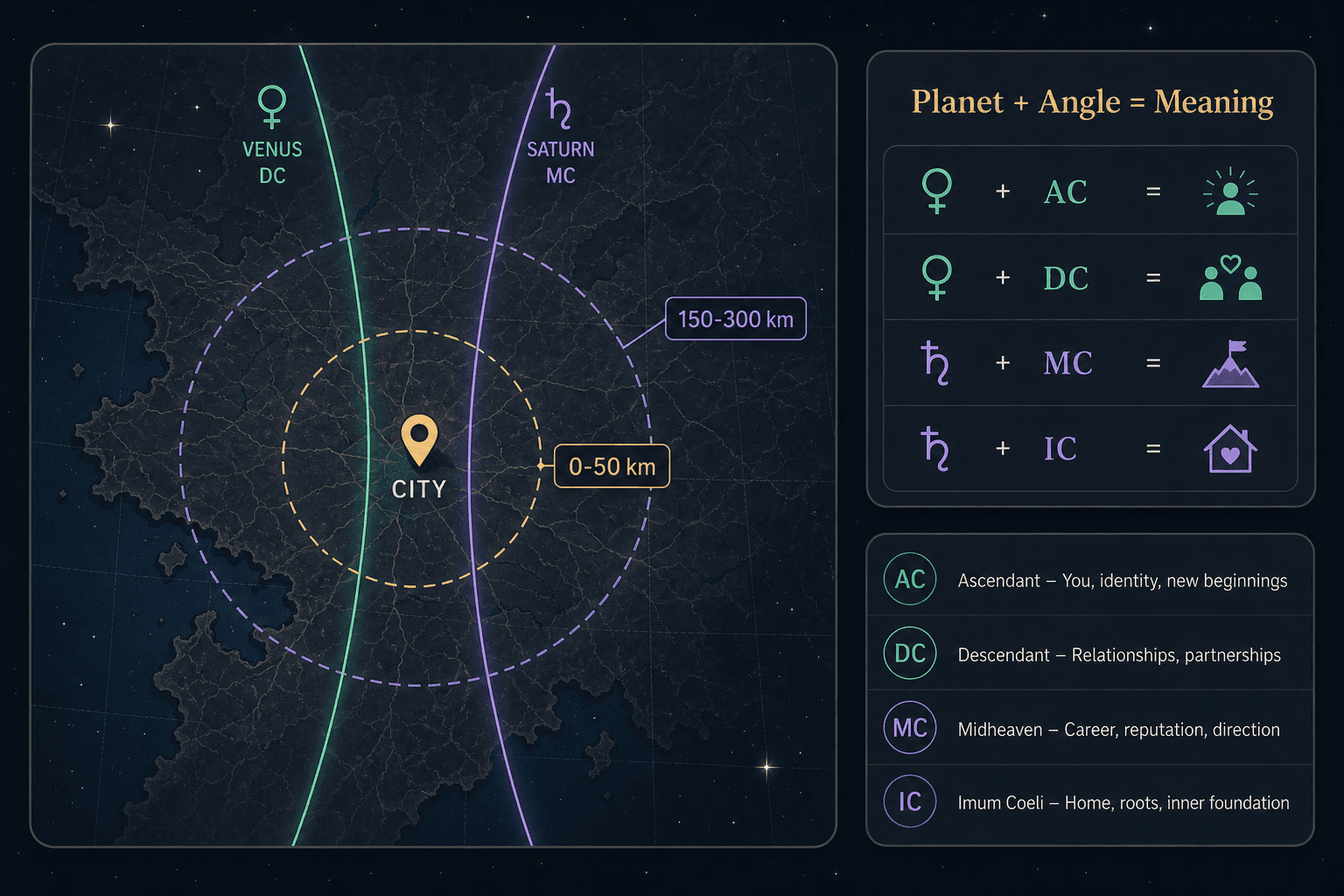
Astrocartography reading diagram showing a city pin, nearby Venus DC and Saturn MC lines, distance rings, and angle meaning legend
A sample city reading showing nearby planetary lines, distance bands, and the Planet + Angle formula.
01

Step 1: Start With One City or Region

Choose one city or region you are considering. It may be where you live now, a city you loved visiting, or a place you are thinking about moving to. Starting with a real location keeps the reading grounded. This first step in how to read astrocartography map analysis grounds everything that follows.

02

Step 2: Identify the Planetary Lines Near That Place

Find the lines that pass through or near that location. Most places only need a few lines for a first reading. If many lines are nearby, start with the closest and the most personally relevant planets. This step in how to read astrocartography map analysis determines which influences to prioritize.

03

Step 3: Understand AC, DC, MC, and IC Lines

The angle changes the meaning. A Venus MC line is not the same as a Venus DC line. The planet describes the type of energy; the angle describes where that energy shows up in life. Understanding how to read astrocartography map angles is crucial because the same planet feels different depending on which angle it touches.

04

Step 4: Check How Close You Are to Each Astrocartography Line

The closer a location is to a line, the stronger that line may feel. A city directly on a line can feel intense. A city within a wider regional range may still matter, but usually in a less concentrated way. How to read astrocartography map distance helps you gauge intensity accurately.

05

Step 5: Combine Planet Meaning With Angle Meaning

Use a simple formula: planet meaning plus angle meaning. For example, Jupiter plus MC may point toward public growth or career opportunity, while Moon plus IC may highlight home, family, and emotional belonging. This formula is the core of how to read astrocartography map synthesis.

06

Step 6: Look for Line Crossings, Parans, and Mixed Energies

If two or more lines meet near one place, the reading becomes more layered. Crossings and parans can blend planetary themes. A supportive planet can soften a difficult one, while two intense planets together may feel powerful but demanding. This advanced step in how to read astrocartography map analysis adds depth to your interpretation.

What AC, DC, MC, and IC Mean in Astrocartography

Every planet can appear on four main angles. These angles are the backbone of astrocartography interpretation. When you understand them, it becomes much easier to read the map without memorizing every possible combination. Knowing how to read astrocartography map angles is essential because the same planet feels completely different on AC versus IC.

AC Line Meaning: Identity, Body, and First Impressions

AC lines are connected with identity, appearance, personal energy, and how you meet the world. A planet on the AC can feel visible and personal. You may express that planet more directly in that location.

DC Line Meaning: Relationships, Partners, and Other People

DC lines are connected with one-on-one relationships. They may describe partners, clients, rivals, teachers, or the kinds of people you attract. If you are exploring love or collaboration, DC lines deserve close attention.

MC Line Meaning: Career, Public Life, and Reputation

MC lines are connected with career, public image, status, ambition, and direction. They can show places where a planet becomes more visible in your outer life. People often check MC lines when comparing cities for work.

IC Line Meaning: Home, Family, Roots, and Inner Life

IC lines are connected with home, family, private life, memory, and emotional roots. A strong IC line can make a place feel deeply familiar, comforting, heavy, or inward, depending on the planet involved.

Astrocartography Lines Meaning by Planet

Planet meanings are not automatically good or bad. Each planet brings a theme, and your natal chart affects how that theme feels. When learning how to read astrocartography map lines, keep the planet meaning flexible and connect it to your real goals. For a complete reference of what each planetary line represents, see our astrocartography lines meaning guide. This section of the how to read astrocartography map guide covers every planet you will encounter when you learn how to read astrocartography map charts.

Sun Line Meaning in Astrocartography

Highlight confidence, visibility, leadership, creativity, and a stronger sense of self. Places where you want to be recognized, create more openly, or feel more connected to your direction. In how to read astrocartography map analysis, Sun lines often indicate where your identity becomes more prominent.

Moon Line Meaning in Astrocartography

Emphasize emotions, intuition, comfort, family, and belonging. Can be nurturing but also sensitive. Useful when you want a place that feels emotionally meaningful or close to home. In how to read astrocartography map readings, Moon lines reveal emotional significance.

Mercury Line Meaning in Astrocartography

Support communication, learning, writing, teaching, business conversations, and networking. These places can feel busy and mentally active, especially for media, education, or online projects. When how to read astrocartography map insights for communication, Mercury lines are key.

Venus Line Meaning in Astrocartography

Associated with love, beauty, harmony, social ease, art, pleasure, and attraction. Helpful for relationships and creative life, but should not be treated as effortless perfection. In how to read astrocartography map for love, Venus lines are particularly significant.

Mars Line Meaning in Astrocartography

Bring action, ambition, courage, heat, competition, and conflict. Support fitness, entrepreneurship, and decisive moves, but may also feel impatient or confrontational if energy is not directed well. Understanding how to read astrocartography map energy with Mars lines requires attention to how drive manifests.

Jupiter Line Meaning in Astrocartography

Point to growth, opportunity, learning, travel, confidence, generosity, and expansion. Excellent for career or personal development, but may also encourage overconfidence or excess. When how to read astrocartography map for growth, Jupiter lines often indicate expansion.

Saturn Line Meaning in Astrocartography

Emphasize discipline, responsibility, structure, long-term work, pressure, and maturity. May feel heavy at first, yet useful for building stability, mastering a craft, or taking life seriously. In how to read astrocartography map analysis, Saturn lines bring serious themes that build over time.

Uranus Line Meaning in Astrocartography

Bring independence, change, freedom, experimentation, disruption, and unexpected breakthroughs. Exciting for reinvention but unstable for people who need predictability and quiet routines. When how to read astrocartography map for change, Uranus lines indicate sudden shifts.

Neptune Line Meaning in Astrocartography

Relate to dreams, spirituality, imagination, compassion, art, and blurred boundaries. May inspire creativity and inner reflection, but can also make practical details harder to see clearly. In how to read astrocartography map for spirituality, Neptune lines are deeply revealing.

Pluto Line Meaning in Astrocartography

Linked with transformation, intensity, power, depth, endings, and rebirth. These places can feel life-changing, but are rarely casual. Pluto locations often ask for honesty and emotional strength. When how to read astrocartography map for transformation, Pluto lines are the most intense.

Chiron Line Meaning in Astrocartography

Can bring healing, old wounds, teaching, wisdom, and vulnerability. May not always feel easy, but can help you understand sensitive patterns and turn personal experience into insight. When how to read astrocartography map for healing, Chiron lines indicate profound wounds that can transform.

North Node and South Node Lines

Point toward growth, future development, and unfamiliar but meaningful direction. The North Node adds a karmic or developmental layer to location reading. Understanding how to read astrocartography map destiny lines through North Node placement reveals future direction. South Node lines point toward familiar patterns, old comfort zones, and skills you may already know. Together, they add a karmic or developmental layer.

How Close to an Astrocartography Line Should You Be?

Distance matters because astrocartography lines work by proximity. This is one of the most practical parts of how to read astrocartography map results. A line through a city is usually stronger than a line several hundred kilometers away. Still, a nearby line can be meaningful, especially if the planet or angle fits your goal. Understanding how to read astrocartography map distance is essential for accurate how to read astrocartography map interpretation.

Reading Lines Within 0–150 km

Lines within this range are usually the first to read. The themes may feel direct, visible, and harder to ignore. If a city is inside this band, include the line in your main interpretation. When how to read astrocartography map proximity is this close, the influence is typically very strong.

Reading Lines Within 150–300 km

Lines in this range can still matter, but they may feel less concentrated. They are worth reading when the planet is important, when the city already attracts you, or when the line matches your purpose. In how to read astrocartography map distance analysis, moderate range still offers meaningful influence.

When Distant Astrocartography Lines Still Matter

Distant lines may matter if you travel toward them often, if parans or local space lines add emphasis, or if current transits activate that planet in your chart. Do not overread distant lines on a first pass. When how to read astrocartography map distance is this great, focus primarily on closer lines.

Why Living Directly on a Line Can Feel Intense

Living exactly on a line may make the planet feel constant. That can be exciting on a Sun or Jupiter line, but even supportive lines can become too much. Sometimes nearby is better than exact. This is an important consideration when how to read astrocartography map distance is very close.

How to Interpret Astrocartography Line Crossings and Parans

Crossings and parans show blended energy. They are important when learning how to read astrocartography map patterns beyond single lines. They add nuance to how to read astrocartography map results because a location may not be described by one planet alone. Always read the strongest line first, then add the crossing as a second layer. When applying how to read astrocartography map knowledge to crossings, remember that combinations create unique effects.

What Parans Mean on an Astrocartography Map

Parans are connected with planets rising, setting, or reaching angles at the same time in a particular latitude. They can create an east-west influence and may be subtler than main lines, but they can still shape the feel of a place. When applying how to read astrocartography map knowledge to parans, remember they add a subtle but meaningful layer.

How Benefic and Challenging Lines Combine

Venus, Jupiter, and the Sun are often experienced as easier, while Saturn, Mars, Pluto, or Uranus may require more awareness. But no planet is only good or bad. A mixed combination can bring growth with pressure. Understanding how to read astrocartography map combinations helps you prepare for complex locations.

When Too Many Lines Cross in One Place

Many lines in one place can be stimulating, but also overwhelming. If a city has several strong lines and crossings, visit first if possible. Your lived experience is an important part of the reading. When how to read astrocartography map hot spots occur, take time to research before making decisions.

How to Use Astrocartography to Choose Where to Live

Astrocartography should support decision-making, not replace common sense. The purpose of how to read astrocartography map information is to compare places more thoughtfully, not to let a map decide your life. The best location depends on your goals, personality, money, language, work, relationships, and real-life needs. The map adds one symbolic layer to a practical decision. For a detailed guide on using your chart to find the best place to call home, see our page on where to live based on astrocartography. Using how to read astrocartography map insights for major decisions should always be balanced with practical considerations.

Best Astrocartography Lines for Career

Sun, Jupiter, Mercury + MC

Sun MC can support visibility, Jupiter MC may support expansion, Mercury MC can support communication work, and Saturn MC may help long-term achievement through discipline. When applying how to read astrocartography map knowledge to career decisions, MC lines should be your primary focus.

Best Astrocartography Lines for Love and Relationships

Venus, Moon + DC

Venus DC may support attraction and partnership, Moon DC can feel emotionally connected, and Jupiter DC may bring generous or growth-oriented relationships. For love-focused how to read astrocartography map analysis, DC lines are typically the most revealing.

Best Astrocartography Lines for Home and Belonging

Moon + IC

Moon IC can feel emotionally rooted, Venus IC can support a beautiful home environment, and Sun IC may create a stronger private sense of identity. For home and family decisions, using how to read astrocartography map insights with IC lines is particularly helpful.

Best Astrocartography Lines for Travel and Personal Growth

Jupiter, Sun, Mercury, Uranus, North Node

The right choice depends on whether you want learning, confidence, freedom, networking, or a new life direction. When exploring travel and growth through how to read astrocartography map techniques, these planetary lines offer the most potential.

What If No Astrocartography Lines Are Near You?

If no major line is near your current city, it does not mean the place has no meaning. A mature approach to how to read astrocartography map results also looks at nearby regions and lived experience. It simply means no main angular line is strongly emphasized there. You can still read nearby regions, short trips, parans, local space lines, and transits. Even when applying how to read astrocartography map principles to line-poor areas, there are always additional factors to consider.

Check Nearby Cities or Regions

Look at cities within the same broader region. A line may not pass through your exact city but may pass through a nearby area. This can still shape regional travel, weekend trips, or future relocation ideas. When how to read astrocartography map analysis shows no major lines nearby, regional exploration is a smart next step.

Use Short Trips to Test a Planetary Line

Short trips are useful because they let you test a line before committing to a move. Keep notes on mood, work flow, relationships, sleep, creativity, and opportunities while you are near the line. Testing how to read astrocartography map insights in person gives you real-world data.

Consider Local Space Lines and Current Transits

Local space lines and current transits add timing and direction. They can explain why a place feels active even without a major astrocartography line nearby. These layers are best used after the main map reading. When basic how to read astrocartography map analysis feels incomplete, these additional factors can provide clarity.

Astrocartography Map vs Relocation Chart

An astrocartography map is a fast visual overview. A relocation chart is a deeper chart for one specific city. If you are serious about moving, use both. First learn how to read astrocartography map patterns, then check the relocated chart for detail. This how to read astrocartography map comparison with relocation astrology gives you two complementary perspectives on any location.

What an Astrocartography Map Can Show Quickly

The map quickly shows which planets are angular in different parts of the world. It is useful for comparing many cities at once and seeing where career, relationship, home, or identity themes may be highlighted. This how to read astrocartography map overview gives you a bird eye view of global influences.

What a Relocated Birth Chart Adds

A relocated birth chart recalculates the angles and houses for a new location while keeping the same birth time and planetary positions. It can show house emphasis and chart details that a simple map does not display. Understanding how to read astrocartography map relocated charts adds precision to your analysis.

When to Use Both for a Deeper Reading

Use the map to shortlist locations, then use a relocated chart to study your top choices. This two-step method prevents you from overreacting to one line while missing the full chart context. Following how to read astrocartography map best practices means using both tools together for major decisions.

Common Mistakes When Reading an Astrocartography Map

Beginners often try to read too much too fast. The safest way to learn how to read astrocartography map lines is to slow down and stay location-focused. The best method is focused, practical, and connected to real life. Learning how to read astrocartography map results also means learning what not to overinterpret. These common how to read astrocartography map pitfalls are worth avoiding as you develop your skills.

Reading Every Line Instead of Relevant Locations

Do not read the entire world map line by line. Pick the places you care about. Then read the closest and most relevant planetary lines for those places. This how to read astrocartography map approach keeps your analysis focused and practical.

Ignoring the Angle and Only Reading the Planet

A planet without the angle is incomplete. Venus AC, Venus DC, Venus MC, and Venus IC can feel different. Always combine the planet with AC, DC, MC, or IC. This how to read astrocartography map principle is fundamental to accurate interpretation.

Treating Venus and Jupiter Lines as Always Easy

Venus and Jupiter are often supportive, but they can still bring laziness, excess, avoidance, or overconfidence. Your natal chart and real-life choices still matter. Understanding how to read astrocartography map nuances prevents oversimplification.

Assuming Saturn, Mars, or Pluto Lines Are Always Bad

Saturn can build discipline, Mars can build courage, and Pluto can bring transformation. These lines may be demanding, but they are not automatically wrong for every person or goal. Learning how to read astrocartography map challenging lines properly reveals their growth potential.

Forgetting to Compare the Map With Real Life Experience

Your experience matters. Compare the map with places you have already lived or visited. This helps you calibrate what each line feels like for you before making future decisions. Validating how to read astrocartography map insights against real experience makes your readings more accurate.

Frequently Asked Questions

How do you read an astrocartography map?

To read an astrocartography map, choose one location, find the nearest planetary lines, read the angle label, then combine the planet meaning with the angle meaning. That is the basic method behind how to read astrocartography map results without getting lost in every line. Following this how to read astrocartography map process step by step will give you reliable insights.

What do the lines mean on an astrocartography map?

The lines show where planets from your birth chart connect with major angles around the world. Each line combines a planet, such as Venus or Saturn, with an angle, such as AC, DC, MC, or IC. For detailed planet-by-planet meanings, refer to our astrocartography lines meaning guide. Understanding how to read astrocartography map lines is fundamental to using this tool effectively.

What is the most important line in astrocartography?

There is no single most important line for everyone. Sun lines may matter for identity, Venus lines for love, Jupiter lines for growth, Saturn lines for discipline, and MC lines for career. The best line depends on your goal. When you learn how to read astrocartography map options, you will find that the most important line varies based on what you are trying to achieve.

How far from an astrocartography line does it matter?

The closest lines matter most. A line within 0–150 km is usually important, while 150–300 km can still be relevant. Distant lines should be read more carefully and usually not as the main factor. How to read astrocartography map distance is a key factor in determining how strongly a line will affect you.

Which astrocartography line is best for love?

Venus DC is often considered one of the clearest relationship lines because Venus relates to attraction and DC relates to partnership. Moon DC and Jupiter DC can also be helpful, depending on what kind of relationship experience you want. When applying how to read astrocartography map knowledge to love matters, Venus DC lines often rise to the top.

Which astrocartography line is best for career?

Jupiter MC, Sun MC, Mercury MC, and Saturn MC can all support career in different ways. Jupiter may expand opportunity, Sun may increase visibility, Mercury may support communication, and Saturn may support long-term structure. For career-focused how to read astrocartography map decisions, MC lines are typically the most relevant.

Can you read an astrocartography map without birth time?

You can explore broad themes, but the reading becomes much less reliable. Because astrocartography depends on angles, an unknown birth time makes exact AC, DC, MC, and IC lines uncertain. How to read astrocartography map accuracy depends heavily on having an accurate birth time.

What does it mean if two astrocartography lines cross?

A crossing means two planetary themes may blend in that place. For example, Venus and Jupiter together may feel social and expansive, while Mars and Pluto together may feel intense, active, and transformative. When you understand how to read astrocartography map crossings, you can identify locations with rich, layered energy.

Is a relocation chart the same as an astrocartography map?

No. A map shows planetary lines across the world, while a relocation chart recalculates your chart for one location. For the clearest result, generate an astrocartography chart first, then use a relocated chart for the cities you are most serious about. Using both how to read astrocartography map tools together gives you the most complete picture.