What Is Astrocartography in Simple Terms
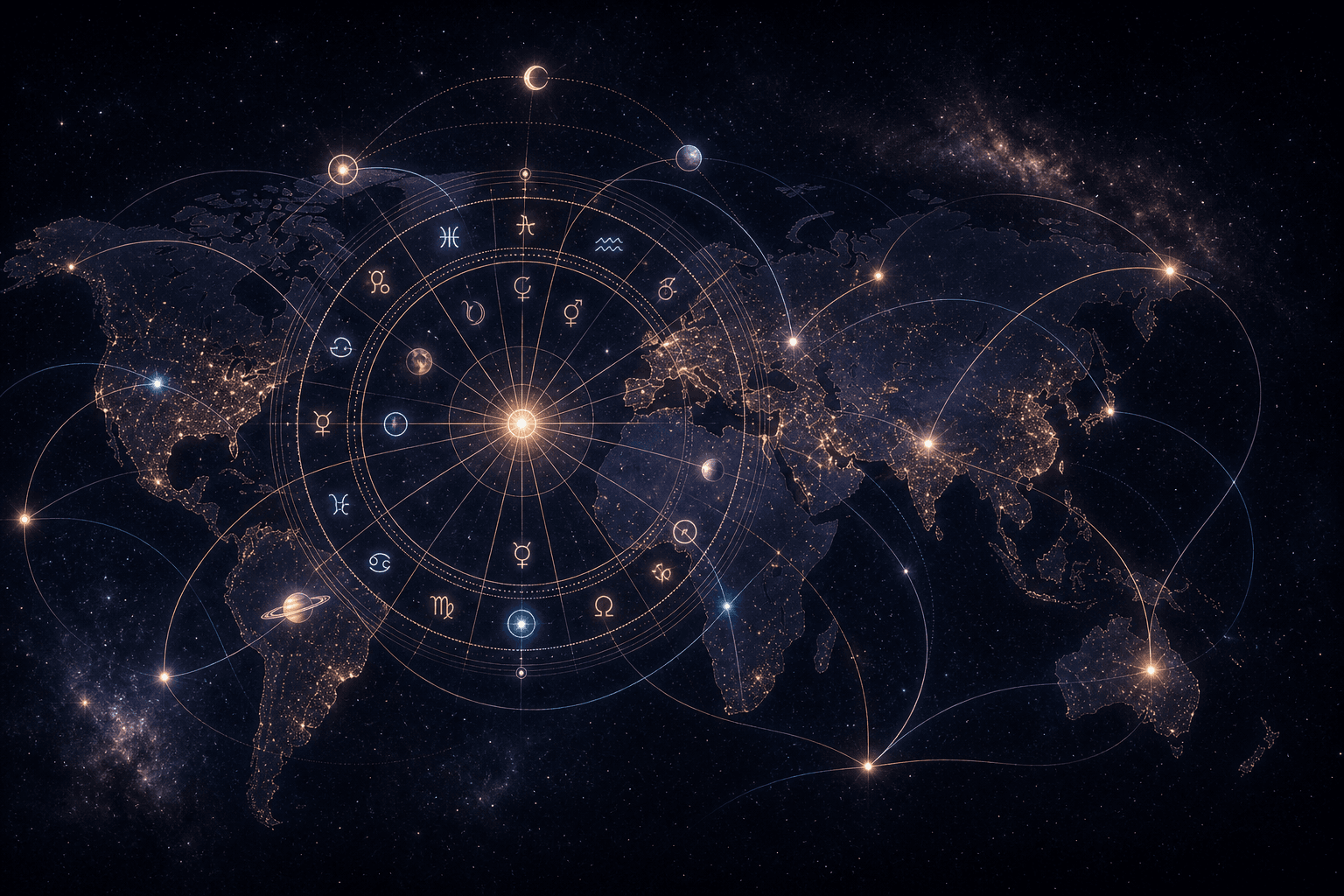
What is astrocartography? What is astrocartography in simple terms? Astrocartography is a branch of astrology that connects your birth chart with places on a world map. Instead of only reading your birth chart as a circle, astrocartography shows where certain planetary energies may feel stronger in different cities, regions, or countries.
An astrocartography map usually displays planetary lines across the world. Each line is linked to a planet, such as the Sun, Moon, Venus, Mars, Jupiter, Saturn, Uranus, Neptune, or Pluto. These lines are often used to explore where you may feel more visible, emotionally comfortable, socially connected, career-focused, disciplined, inspired, or challenged.
If you are asking what is astrocartography because you are planning travel, relocation, or comparing places to live, the easiest starting point is to create your astrocartography chart and look at which planetary lines appear near the places you care about. The map does not make a fixed decision for you, but it gives you a symbolic way to compare locations.
How Astrocartography Connects Your Birth Chart to Places
Astrocartography begins with your natal chart. Your natal chart is based on the date, time, and place of your birth. The same chart can then be projected onto a world map to show where different planets become more emphasized through location.
So, what is astrocartography in relation to your birth chart? What is astrocartography if not a geographic extension of your natal chart? It is not separate from your birth chart. It is another way to view the same birth information through geography. A normal birth chart shows planets, signs, houses, and angles in a circular format. An astrocartography chart spreads some of that information across the globe, helping you compare how different places may activate different parts of your chart.
Why Birth Date, Birth Time, and Birth Place Matter
Birth date, birth time, and birth place matter because astrocartography depends on the exact sky pattern at the moment you were born. The birth date shows where the planets were in the zodiac. The birth place gives the starting location for calculating the chart. The birth time is especially important because it affects the chart angles.
What is astrocartography without accurate birth time? If your birth time is inaccurate, the lines on your astrocartography map can shift. This matters because a line near one city may appear farther away when the time is corrected. For beginners, this means you should use the most accurate birth time available before making strong interpretations.
How Planetary Lines Are Projected onto a World Map
Planetary lines are created by showing where a planet was angular at the time of your birth. In astrology, a planet becomes especially noticeable when it is connected to one of the main angles: Ascendant, Descendant, Midheaven, or Imum Coeli. Astrocartography takes those angular positions and maps them across the world.
This is why a map may show a Sun line running through one part of the world, a Venus line somewhere else, and a Saturn line in another region. Each line represents a place where that planet's symbolism may become more active in your experience. What is astrocartography if not a visual guide to these planetary influences?
What an Astrocartography Chart Shows
An astrocartography chart shows planetary lines, line labels, and the areas where different planetary themes may feel stronger. For example, a Sun line may point to visibility and identity, while a Moon line may point to home, emotions, and belonging.
What is astrocartography useful for at this stage? What is astrocartography if not a tool for location pattern recognition? What is astrocartography but a symbolic map of planetary influences? It helps you see location patterns instead of guessing blindly. You can compare places for career, love, home, creativity, study, travel, or long-term living. The chart is not a guarantee, but it gives you a structured way to ask better questions about place.
How Does Astrocartography Work?
Astrocartography works by combining planetary meanings with geographic location. It asks: where in the world was each planet most strongly connected to the chart angles at the moment of birth? Those areas are then shown as map lines.
The meaning of a line depends on both the planet and the angle. What is astrocartography without understanding planet-angle combinations? A Venus line can feel different on the Ascendant than on the Midheaven. A Mars line can feel motivating in one context and stressful in another. This is why reading astrocartography is not just about finding "good" or "bad" lines. It is about understanding the type of energy a place may highlight.
The Role of Planets in Astrocartography
Planets describe the main themes of a line. The Sun relates to identity, confidence, and visibility. The Moon relates to emotions, home, and belonging. Mercury relates to communication, learning, movement, and business. Venus relates to love, beauty, harmony, and social ease.
Mars can bring drive, action, ambition, and sometimes conflict. Jupiter is linked with growth, opportunity, and expansion. Saturn points to discipline, responsibility, structure, and long-term results. Uranus brings freedom, change, and reinvention. Neptune brings spirituality, dreams, creativity, and confusion. Pluto points to transformation, power, and shadow work.
The Four Angles: AC, DC, MC, and IC
The four main angles give the planet a specific life area. AC, or Ascendant, is connected with identity, appearance, and how you show up. DC, or Descendant, is connected with relationships, partners, and other people. MC, or Midheaven, is connected with career, public life, reputation, and direction. IC, or Imum Coeli, is connected with home, family, roots, and private life.
For example, Venus AC may feel like increased attractiveness, confidence, and social charm. Venus DC may focus more on partnership and close relationships. Venus MC may connect beauty, creativity, or harmony with career. Venus IC may bring comfort and ease into the home environment.
Why Some Locations Feel Stronger Than Others
Some locations feel stronger because they are closer to a planetary line or because multiple influences overlap. A place near a major line may feel more directly connected to that planet's symbolism. A place where lines cross can feel more intense because multiple planetary themes are active together.
However, distance is not the only factor. Your natal chart also matters. A planet that is complicated in your birth chart may not feel simple just because the line is traditionally seen as pleasant. This is why what is astrocartography cannot be answered by line meanings alone. What is astrocartography without your personal chart context? The full chart context matters. What is astrocartography but a guide, not a guarantee?
What It Means When No Lines Are Nearby
If there are no major astrocartography lines near a city, it does not mean the place is empty or meaningless. What is astrocartography when lines are absent? It may simply mean the location is not strongly activating one of the main planetary angle lines on the map.
For beginners, a no-line area can feel more neutral, steady, or less extreme. It may be easier to live daily life there without one planetary theme dominating the experience. What is astrocartography in areas with no major lines? You can still compare that place through your relocation chart, local space lines, personal experiences, and practical life needs.
What Do Astrocartography Lines Mean?
Astrocartography lines describe the planetary themes that may be emphasized in a location. A line does not promise one exact event. Instead, it gives a symbolic pattern. When you ask what is astrocartography, one of the most important answers is this: it is a map of potential location-based themes, not a fixed prediction.
What is astrocartography lines meaning all about? If you want a deeper breakdown of what each planetary line means across different life areas, check out our guide on astrocartography lines meaning for planet-by-planet explanations.
Sun Lines: Identity, Confidence, and Visibility
Sun lines are connected with identity, vitality, leadership, and recognition. A Sun line may help you feel more seen, more confident, or more connected to who you are. Sun MC lines can support career visibility and public image. Sun AC lines can feel personally energizing and self-expressive.
Moon Lines: Emotions, Home, and Belonging
Moon lines are linked with emotions, memory, home, and belonging. A Moon line can make feelings stronger and bring attention to family, comfort, safety, and personal needs. Moon IC lines may feel especially connected to home life, while Moon MC lines can make emotional intelligence more visible in work or public life.
Mercury Lines: Communication, Learning, and Business
Mercury lines are connected with thinking, speaking, writing, study, travel, and business. These places may feel busy, mentally active, and full of movement. A Mercury MC line can support communication-based work, while Mercury DC may emphasize client relationships, negotiation, and dialogue.
Venus Lines: Love, Beauty, and Social Ease
Venus lines are often associated with love, attraction, beauty, pleasure, creativity, and social harmony. A Venus line may support dating, friendship, art, design, comfort, and a more graceful lifestyle. However, Venus is not automatically perfect for everyone. The natal condition of Venus still matters.
Mars Lines: Drive, Action, and Conflict
Mars lines bring energy, courage, ambition, and action. These places can help you start projects, train harder, compete, or take bold steps. The challenge is that Mars can also increase impatience, stress, arguments, or conflict. Mars lines often require healthy outlets for energy.
Jupiter Lines: Growth, Luck, and Opportunity
Jupiter lines are linked with expansion, learning, opportunity, confidence, and abundance. They may support growth in career, education, travel, mentorship, or personal development. But Jupiter can also exaggerate. Overconfidence, overpromising, or relying too much on luck can become issues.
Saturn Lines: Discipline, Responsibility, and Long-Term Results
Saturn lines are connected with structure, responsibility, maturity, discipline, and earned achievement. Life near a Saturn line may feel serious or demanding, but it can also support long-term building. Saturn lines are not always easy, but they may help create stable results through effort.
Uranus Lines: Freedom, Change, and Reinvention
Uranus lines bring independence, innovation, sudden change, and reinvention. These places may push you to live differently, break old patterns, or explore unconventional paths. Uranus can be exciting, but it can also feel unstable if you need routine and predictability.
Neptune Lines: Spirituality, Dreams, and Confusion
Neptune lines are connected with spirituality, imagination, creativity, compassion, and dreams. They may support meditation, art, music, film, healing, or retreat-like experiences. The challenge is confusion, idealization, weak boundaries, or seeing what you want to see instead of what is real.
Pluto Lines: Transformation, Power, and Shadow Work
Pluto lines are intense. They are linked with transformation, power, shadow work, rebirth, and deep psychological change. A Pluto line may bring buried patterns to the surface. It can be powerful for inner work, but it is rarely light or casual. It often asks for honesty, strength, and self-awareness.
What Can Astrocartography Tell You?
Astrocartography can tell you which places may emphasize different life themes. It can help you compare cities for career, love, home, growth, travel, or personal reinvention. It should not replace real-world planning, but it can add another layer of reflection.
What is astrocartography best used for? It is best used as a guide for exploring possibilities. What is astrocartography supposed to help you discover? You can use it to ask: where might I feel more visible? Where might relationships become more important? Where might I feel emotionally safe? Where might life become more disciplined, exciting, or transformative?
Finding Places for Career and Public Life
For career and public life, MC lines are especially important. Sun MC can support visibility and recognition. Mercury MC can support writing, speaking, media, teaching, analysis, or business communication. Venus MC may support creative, beauty, design, or relationship-based professions. Jupiter MC may bring expansion, mentors, leadership, or professional opportunity. Saturn MC may bring responsibility and long-term achievement.
If your goal is professional growth, you can generate an astrocartography map and compare which MC lines appear near the cities you are considering.
Exploring Love, Relationships, and Social Connection
For love and relationships, Venus lines are often the first place beginners look, especially Venus DC lines. But relationship themes can also appear through Moon, Sun, Jupiter, Neptune, Pluto, or Mars lines depending on the type of connection. Moon may bring emotional closeness, Jupiter may bring supportive people, Neptune may bring idealization, and Pluto may bring intensity.
Astrocartography does not guarantee that one city will bring a perfect relationship. It shows the kind of relationship energy that may be highlighted.
Understanding Home, Family, and Emotional Safety
For home and emotional safety, IC lines and Moon lines are important. Moon IC may feel familiar, nurturing, or family-centered. Venus IC can support comfort and beauty at home. Jupiter IC can feel expansive and generous for family life. Saturn IC may bring responsibility or structure in the private world.
When asking what is astrocartography for home decisions, the answer is not simply "find the easiest line." What is astrocartography supposed to guide you toward? It is better to ask which place supports the kind of home life you actually want.
Comparing Travel, Relocation, and Long-Term Living
A place that feels exciting for travel may not be ideal for long-term living. Uranus may be thrilling for reinvention, but unstable for routine. Neptune may feel magical on retreat, but unclear for practical commitments. Mars may be energizing for a short push, but tiring if conflict builds.
What is astrocartography without clear life goals? This is why astrocartography works best when compared with real goals. A city for career growth, a city for healing, and a city for romantic ease may not be the same place.
Astrocartography Map vs Relocation Chart
An astrocartography map and a relocation chart are related, but they are not exactly the same. The map gives a broad geographic overview of planetary lines. A relocation chart recalculates the birth chart for a specific location, showing how the houses and angles change there.
What is astrocartography compared with relocation astrology? What is astrocartography in the context of place-based astrology? Astrocartography is the map-based view. Relocation astrology is the broader practice of understanding how a place changes the expression of your chart.
What an Astrocartography Map Is Best For
An astrocartography map is best for scanning the world quickly. It helps you compare multiple regions and identify the planetary lines near cities you care about. It is useful when you are exploring possibilities, narrowing down options, or trying to understand why certain places feel different.
For beginners, the map is the easiest starting point because it gives a visual overview.
When to Look at a Relocation Birth Chart
A relocation birth chart is helpful when you are seriously considering one specific place. It can show how your chart houses shift in that location. For example, a planet that was in one area of life in your birth chart may become more connected to career, relationships, home, or personal identity in a relocation chart.
The best approach is to use the astrocartography map first, then look deeper into a relocation chart for the places that matter most.
How to Read an Astrocartography Chart as a Beginner
To read an astrocartography chart as a beginner, start simple. Do not try to interpret every line on the map at once. Choose one city, identify nearby lines, read the planet and angle, then compare the meaning with your real-life goal.
What is astrocartography supposed to help you do here? What is astrocartography if not a decision-making companion? It helps you organize location questions. Instead of asking "Where is the best place?" you ask "Best for what?"
For a complete step-by-step walkthrough with practical examples, see our guide on reading astrocartography maps.
Step 1: Start with One City or Region
Begin with one city or region you already care about. This could be where you live now, a place you want to visit, or a city you are considering for relocation. Starting with a real place keeps the reading practical.
Step 2: Find the Closest Planetary Lines
Next, find the closest planetary lines to that city. Look at the planet name and angle label. For example, you might see Sun MC, Venus DC, Moon IC, or Saturn AC. Do not only look for Venus and Jupiter. Every line can be useful depending on your goal.
Step 3: Combine Planet Meaning with Angle Meaning
After identifying the line, combine the planet meaning with the angle meaning. Venus plus DC may point to relationships and social harmony. Saturn plus MC may point to serious career responsibility. Moon plus IC may point to emotional roots and family life. This combined reading is more useful than reading the planet alone.
Step 4: Check Line Distance and Crossings
Line distance matters because closer locations may feel more strongly connected to the line. Crossings also matter because two or more planetary energies may overlap. A Venus and Jupiter crossing may feel socially or creatively expansive, while Mars and Saturn together may require effort, patience, and endurance.
Step 5: Compare the Map with Your Real-Life Goals
Finally, compare the map with practical goals. If you want career visibility, a Sun MC or Jupiter MC theme may be useful. If you want emotional rest, a Moon IC or Venus IC theme may fit better. If you want reinvention, Uranus may be relevant. If you want deep inner work, Pluto may be meaningful. You can make an astrocartography chart online and use it as a starting point for this comparison.
Is Astrocartography Accurate or Real?
Astrocartography is not scientifically proven as a causal system. From a scientific perspective, astrology is often criticized because it is not easily testable in the same way as scientific theories, and it can be affected by confirmation bias.
At the same time, many people use astrocartography as a symbolic and psychological tool. What is astrocartography from a practical perspective? In that sense, the better question may not be only "Is it scientifically real?" but "Does it help me reflect on place, choice, identity, and life direction in a useful way?"
Why Astrocartography Should Be Used as a Guide
Astrocartography should be used as a guide, not a fixed rule. It can help you think about different places, but it should not replace practical research, financial planning, immigration rules, job opportunities, housing costs, safety, health, family needs, or real-world experience.
What is astrocartography most helpful for? What is astrocartography at its core? It is helpful for reflection. It gives language to the feeling that different places bring out different parts of you.
Common Mistakes When Interpreting Astrocartography
A common mistake is thinking every Venus or Jupiter line is automatically good, while every Mars, Saturn, or Pluto line is automatically bad. What is astrocartography without nuanced interpretation? In reality, each planet is filtered through your birth chart and your life situation.
Another mistake is relying only on lines without considering relocation charts, timing, personal goals, or lived experience. What is astrocartography when oversimplified? Some people also assume that no nearby lines means nothing is happening, but a place can still matter through other chart techniques and real-life circumstances.
Frequently Asked Questions
What is astrocartography used for?
What is astrocartography and what can you do with it? Astrocartography is used to explore how different places may connect with themes in your birth chart. People often use it for travel planning, relocation, career decisions, love and relationship exploration, home life reflection, and personal growth.
Is astrocartography the same as relocation astrology?
What is astrocartography in relation to relocation astrology? Astrocartography is part of relocation astrology, but they are not exactly the same. Astrocartography focuses on map lines across the world. Relocation astrology can also include a relocated birth chart and other techniques for studying one specific place more deeply.
Can astrocartography show where I should live?
What is astrocartography capable of telling you about where to live? Astrocartography can suggest places that may support certain themes, but it should not make the decision for you. A good place to live also depends on work, money, family, health, safety, lifestyle, and practical needs.
What is the most important line in astrocartography?
What is astrocartography without the right line selection? There is no single most important line for everyone. The best line depends on your goal. Sun lines may support confidence and visibility. Venus lines may support love and ease. Jupiter lines may support growth. Saturn lines may support long-term discipline. Moon lines may support home and emotional belonging.
Do you need an exact birth time for astrocartography?
What is astrocartography without accurate birth data? Yes, an accurate birth time is very important. Astrocartography depends on chart angles, and those angles can shift when the birth time changes. If the time is wrong, the map lines may not be placed accurately.
What if my astrocartography map has no lines near me?
What is astrocartography when no lines appear nearby? If your map has no major lines near your current location, it does not mean the place has no meaning. It may feel more neutral or less dominated by one planetary theme. You can still study the relocation chart, compare nearby regions, and reflect on your real experience there.
Are Venus and Jupiter lines always good?
What is astrocartography without understanding line complexity? No. Venus and Jupiter lines are often seen as supportive, but they are not always simple. Venus can bring relationship lessons as well as pleasure. Jupiter can bring opportunity, but also excess or overconfidence. Every line should be read with your full birth chart, your goals, and your real-life situation.