Your map, one symbol at a time
Astrocartography Symbols and Meanings
Find a planet symbol, add its angle, and understand the label on your map. No birth details or account needed.
Astrocartography Symbol Key
No birth details or account neededFind a symbol, then add the angle printed beside it.
Which symbol are you looking at?
Choose a planet above or paste a label. Add its angle to decode the complete line.
This is a symbol reference. It does not calculate a personal line location or predict an outcome.
01 / The planet
Astrocartography Planet Symbols: Sun, Moon and More
Astrocartography symbols identify a planet and angle. This astrocartography symbol key matches each glyph to its name and our map label.

See planet shapes and meanings
| Symbol / planet | Our map label | How to recognize it | Astrological theme |
|---|---|---|---|
| Sun | Su | A circle with a dot in its center. | identity, vitality and self-expression |
| Moon | Mo | A crescent; its direction can vary between fonts. | emotions, care and belonging |
| Mercury | Me | A circle with a cross below and a crescent above; the top distinguishes it from Venus. | communication, learning and exchange |
| Venus | Ve | A circle with a small cross below. | relationships, values and beauty |
| Mars | Ma | A circle with an arrow pointing outward. | action, drive and assertion |
| Jupiter | Ju | A curved, crossed shape resembling a stylized number 4. | growth, learning and exploration |
| Saturn | Sa | A cross above a curved lower stroke. | structure, responsibility and boundaries |
| Uranus | Ur | An H-like shape above a small circle; some maps use ⛢ instead. | independence, change and experimentation |
| Neptune | Ne | A trident with a cross below. | imagination, ideals and sensitivity |
| Pluto | Pl | A combined P-and-L shape; some charts use a circle above a crescent and cross instead. | power, intensity and transformation |
Sun and Moon are included in the traditional astrological “planet” grouping. These themes describe astrological interpretations; they are not predictions about what will happen in a place.
Pluto, Uranus and Other Symbol Variants
A different-looking glyph can name the same body. Match the name in the map’s legend before deciding that you have found another planet.
Pluto
The P-like symbol ♇ combines P and L. Some charts use a circle above a bowl and cross. Both forms can represent Pluto; our map uses Pl.
Uranus
You may see the H-like ♅ or the alternative ⛢. Both identify Uranus. The abbreviation on our map is Ur.
Glyph reference:Unicode astronomical symbolsUnicode Pluto variants
Chiron and lunar nodes on other maps
Chiron
Often drawn like a key.
North Node
One of the two lunar nodes.
South Node
The opposite lunar node.
These are reference symbols only. Our current calculator maps Sun through Pluto; it does not calculate Chiron or lunar-node lines.
02 / The angle
What AC, DC, MC and IC Mean
The planet gives the theme. AC, DC, MC and IC identify its position on the horizon or meridian. See the four positions, then explore their meanings.
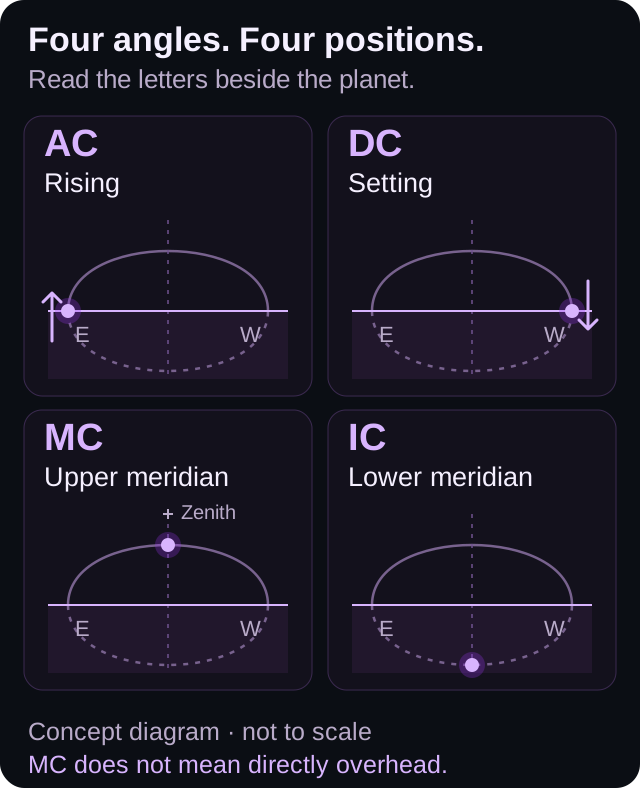
Compare angle names, aliases and meanings
AC
Ascendant
Also written: AC / AS / ASC
- Position
- Rising at the eastern horizon.
- Astrological setting
- identity, self-presentation and beginnings
DC
Descendant
Also written: DC / DS / DSC
- Position
- Setting at the western horizon.
- Astrological setting
- partnerships and one-to-one encounters
MC
Midheaven
Also written: MC
- Position
- Crossing the upper meridian.
- Astrological setting
- career, reputation and public life
IC
Imum Coeli
Also written: IC
- Position
- Crossing the lower meridian.
- Astrological setting
- home, roots and private life
AC, AS and ASC are names for the same angle, as are DC, DS and DSC. These spelling differences do not create extra lines. MC and IC describe the upper and lower meridian; MC does not mean a planet is directly overhead.
03 / Put them together
How to Read Astrocartography Chart Symbols
This astrocartography symbols guide breaks one label into two parts. Read the planet first, then its angle.
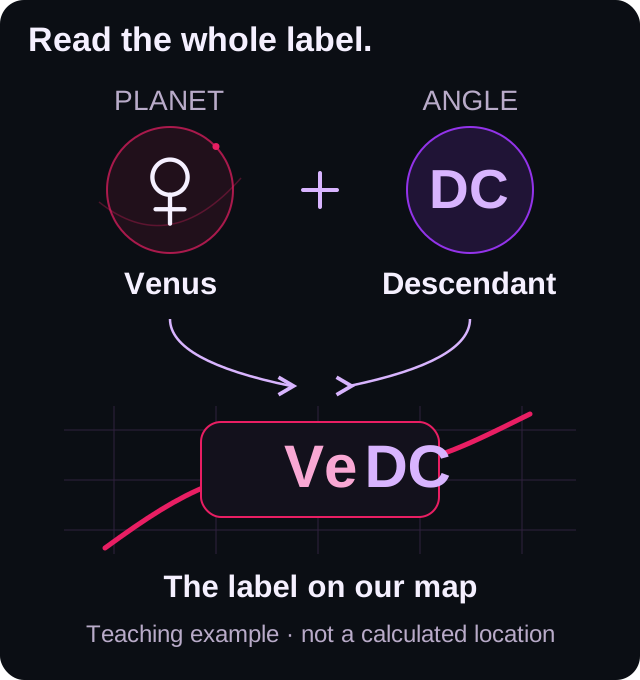
Venus + Descendant
Venus DC pairs Venus themes with partners and one-to-one relationships.
Venus + Midheaven
Venus MC pairs the same themes with public life, reputation and work.
The planet stays the same; the angle changes the interpretation. Neither combination guarantees love, success or a good place to live.
Read the three steps in detail
- 01
Identify the Planet
Venus
Match the glyph to a name. Here, ♀ is Venus; the same planet appears as Ve on our map.
- 02
Add the Angle
Descendant
Read the letters beside the planet. DC, DS and DSC all mean Descendant, the setting angle.
- 03
Check the Complete Line Label
Venus Descendant
Keep both parts together. You have identified one Venus line, rather than every line associated with Venus.
Astrocartography Symbols Explained: Venus DC vs. MC
04 / Check the legend
Why Colors and Line Styles Differ Between Maps
An astrocartography key is specific to its map. On ours, Venus is pink, Jupiter is purple and all main lines are solid. Read the full label to tell them apart.
Compare color and line-style rules across maps
| Map | Its main-line convention | What to check |
|---|---|---|
| Astrocartography Chart — this site | Planet colors with solid main lines for AC, DC, MC and IC. | The full text label, such as Ve DC or Ju MC. |
| Astrology Lines | Solid AC / MC; dashed DC / IC. | Its own angle label and planet legend. |
| Augurine | Solid MC / IC; dashed ASC / DSC. | Its own angle label and planet legend. |
These are product-specific display rules, not different meanings for the planets. A line’s thickness can also indicate selection. Use the written planet–angle label to resolve ambiguity.
05 / From the key to the map
Find Astrocartography Chart Symbols on Your Map
On our map, ♀ becomes Ve and ♃ becomes Ju. Keep the angle attached: Ve DC is Venus Descendant; Ju MC is Jupiter Midheaven.
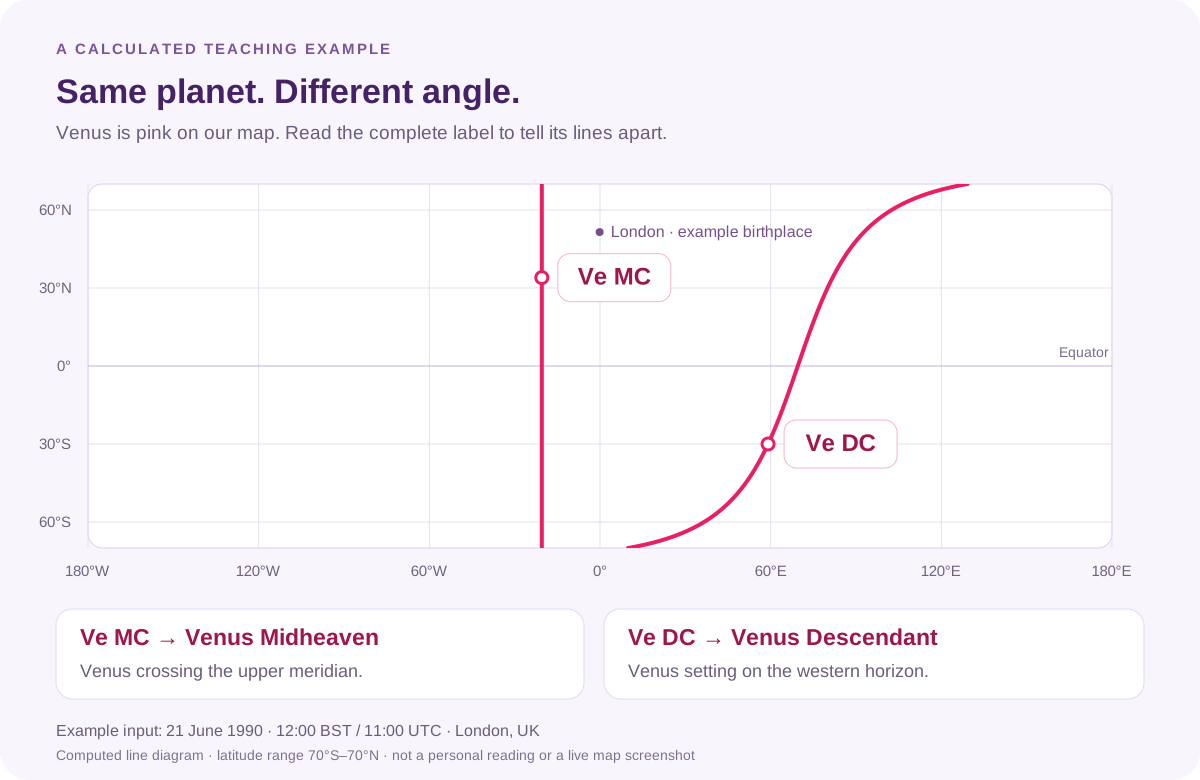
Example input and limits
Calculated teaching diagram from our chart engine for a fictional example, not a screenshot or a personal reading. Input: 21 June 1990, 12:00 BST (11:00 UTC), London, 51.5074° N, 0.1278° W. Only Venus MC and DC are displayed here.
- 1
Turn on Labels
Generate your chart, then enable Labels in the Astro Map panel. On a phone, open Map controls first.
- 2
Keep one planet in view
Use the planet buttons to hide unrelated lines. Zoom in or move the map if the labels overlap.
- 3
Confirm the angle
Read the complete label and use the AC, DC, MC and IC controls to narrow the view. Restore the other lines when you are ready to compare.
Looking up a symbol needs no personal data. Calculating your own line locations requires your birth date, time and place; an uncertain birth time can change those locations.
Keep the key close
Astrocartography Symbols Cheat Sheet
Keep ten planet glyphs, map labels and four angles on one page. Download the SVG, print it or save it as a PDF.
The cheat sheet identifies symbols and labels. It does not calculate your chart or recommend where to move.
Back to the symbol finder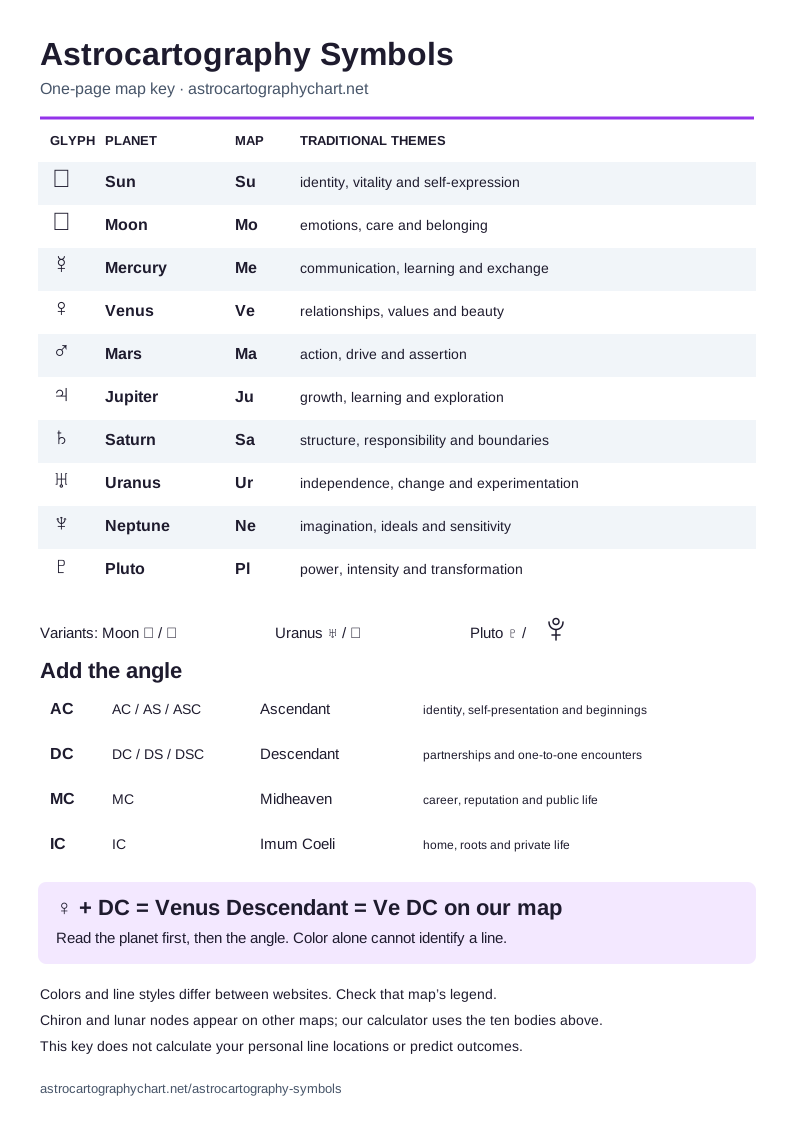
More about your map key
Astrocartography Symbols FAQ
What do astrocartography symbols mean?
Read astrocartography symbol meanings in two parts: the planet identifies the body, and the angle identifies the line. For example, ♀ DC means Venus Descendant. Read both before using an astrological interpretation; a glyph on its own is only half the label.
How can I identify a symbol if I do not know its name?
Compare its shape with the ten symbols in the finder or the table. You can click a glyph directly. Check small details: Mercury has a curved top above its circle, while Venus has a circle and cross without that top.
What do AC, ASC and AS mean, and are they the same?
All three abbreviations mean Ascendant, the rising angle. Our map uses AC. The different spellings identify the same angle; they are not three separate kinds of line.
What is the difference between DC, MC and IC?
DC is Descendant, the setting angle; MC is Midheaven, the upper meridian; IC is Imum Coeli, the lower meridian. Astrologers associate them with relationships, public life and private foundations respectively.
Why does the same planet appear on more than one line?
One planet can be rising, setting, on the upper meridian or on the lower meridian at different places at the same moment. Those positions create its AC, DC, MC and IC lines. The angle distinguishes them.
Which symbol is the Sun line on an astrocartography map?
The Sun glyph is ☉, a circle with a dot at its center. Our map uses Su. Look for the angle too: Su MC and Su IC identify different Sun lines.
How do I recognize the Venus and Jupiter symbols?
Venus is ♀, a circle above a cross. Jupiter is ♃, a curved mark resembling a stylized 4. Our map abbreviates them as Ve and Ju. Color alone is not enough because palettes differ between websites.
What does the P-like Pluto symbol mean?
The P-like ♇ is a traditional Pluto glyph that combines P and L. Some maps use a circle above a bowl and cross instead. Both forms can indicate Pluto; check the map legend. On our map, Pluto is labeled Pl.
Why is the same planet a different color on another website?
Each product chooses its own palette. A pink Venus line here might be green elsewhere. Match the planet name or glyph and the angle rather than carrying a color rule from one map to another.
Do solid and dashed lines always mean the same thing?
No. Astrology Lines uses solid AC/MC and dashed DC/IC, while Augurine uses solid MC/IC and dashed ASC/DSC. Our main planetary lines are solid for all four angles. Always check the legend of the map you are reading.
What should I do when labels overlap or sit at the edge of the map?
Turn on Labels, zoom in or pan, and hide unrelated planets using the map controls. Then read the complete planet–angle label. On mobile, open Map controls to reach those options. Turn the other planets back on when you want the wider context.
Do I need my birth time just to look up a symbol?
No. This symbol finder and the printable key work without birth details, an account or a payment. You need birth details when you want the calculator to place your own lines on a map.
Why does this map use Ve or Ju instead of planet glyphs?
Our map uses short text labels: Ve is Venus and Ju is Jupiter. They identify the same bodies as ♀ and ♃. The angle follows the abbreviation, so Ve DC corresponds to Venus Descendant.
Where are Chiron and the lunar nodes on this map?
The current calculator maps ten bodies, Sun through Pluto. It does not calculate Chiron or lunar-node lines. Their symbols appear in this guide only to help you recognize them on other providers’ maps.
Can I print the symbol key, and will it tell me where to move?
You can print the cheat sheet or download its SVG. It helps identify planets, abbreviations and angles, but it is not a personal location reading. For relocation questions, compare your chart with practical information about the places you are considering.